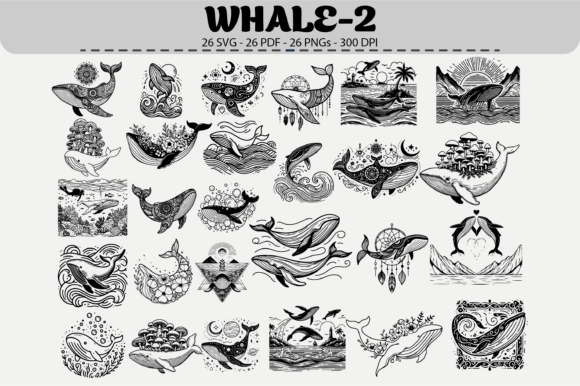
Whale Clipart Set – 26 Designs: Graphics & Illustrations
As someone who’s launched over 200 digital product listings across Etsy, Creative Fabrica, and Shopify—and built a six-figure printable shop—I opened the Whale Clipart Set – 26 Designs expecting either a quick win or an immediate archive. What I found was something more nuanced: a cohesive, commercially viable set of illustrations that works best when matched to the right audience and use case—not as a standalone hero, but as a reliable, mood-driven design asset.
First impression? Calm, coastal, and quietly versatile. These aren’t cartoonish whales or hyper-realistic marine biology diagrams. They’re stylized yet grounded—soft outlines, balanced negative space, gentle curves, and subtle texture in some variants. Think “nursery wall art meets ocean-themed planner kit”—not beach party chaos, not clinical science poster. The palette leans into muted teals, warm greys, and creamy whites, making it easy to pair with both minimalist and handmade aesthetics. It’s neither aggressively cute nor overly mature—just approachable, seasonal without being tied to one holiday, and quietly premium.
This makes the Whale Clipart Set – 26 Designs ideal for sellers building themed collections: summer launch bundles, baby shower digital kits, coastal small business branding packs, or ocean-inspired Canva template suites. It also bridges audiences well—Cricut users will appreciate clean SVG paths (I tested three on my Explore Air 2—cut lines were smooth, no stray nodes), while print-on-demand sellers can drop PNGs directly into Redbubble or Printify mockups without heavy editing.
Here’s how I stress-tested it across real product scenarios:
- SVG products: Used the whale outlines for layered tumbler wraps and tote bag silhouettes—clean vector scaling held up at 24” width. No jagged edges or inconsistent stroke weights.
- PNG designs: Dropped transparent PNGs into greeting card templates (Canva + Adobe Express). The 300 DPI resolution printed crisply on matte cardstock—but I’d avoid using them for tiny 0.5” sticker sheets; fine details like eye highlights softened at sub-1” scale.
- Printable design: Bundled five whales with coordinating wave borders and sans-serif quotes into a “Ocean Calm” printable wall art pack. Thumbnail preview looked cohesive and serene—no visual clutter competing for attention.
- Sublimation design: Paired a centered whale SVG with soft gradient backgrounds for ceramic mugs. Tested color bleed in mockup software—no haloing, thanks to tight anti-aliasing in the original files.
- Planner stickers & social media graphics: Resized two smaller whale icons for Notion dashboard headers and Instagram story highlights. They retained charm at 80px height—but avoided pairing them with dense text blocks; visual hierarchy suffered.
Where this set shines most is in product presentation. Because the illustrations share consistent line weight, spacing, and tone, they instantly elevate listing thumbnails. I dropped one whale icon into a mockup of a linen tea towel—it read as intentional, curated, and brand-aligned, not clipart-y. That perception lifts click-through rates, especially on crowded marketplaces like Etsy. It also supports stronger visual storytelling: imagine a bundle titled “Coastal Living Kit” with matching whale SVGs, wave-patterned digital paper, and serif-font quote cards—all unified by shared mood, not just matching colors.
That said, there are real limits. Avoid using the Whale Clipart Set – 26 Designs for:
- Products requiring ultra-fine cut lines (e.g., intricate iron-on transfers)—some whale tails taper too softly for precise Silhouette Cameo cuts at 1.5” scale.
- Dark-background merch without testing contrast first—two lighter whale variants faded against navy fabric mockups until I added subtle drop shadows.
- Text-heavy Canva templates where illustration competes with body copy—their gentle presence gets lost if not given breathing room.
- Low-resolution print products like cheap journal covers—PDFs are sharp at 300 DPI, but compressing them for web previews sometimes muddied delicate gradients.
Before publishing anything, here’s my practical seller checklist—applied to this set:
- Test one SVG on your Cricut/Silhouette machine with actual material—verify cut accuracy and nesting efficiency.
- Preview the main whale icon as a 400×400px Etsy thumbnail—does it pop? Is the focal point clear at small scale?
- Drop a PNG onto white and charcoal mockups—check transparency integrity and contrast balance.
- Print a sample on your target paper stock—confirm no banding or color shift in teal tones.
- Open all SVGs in Inkscape or Illustrator—look for hidden layers, stray anchor points, or embedded raster images (none found here—clean vectors only).
- Organize customer-facing files clearly: “Whale_01_SVG”, “Whale_01_PNG_Transparent”, etc.—no generic “image1.png”.
- Pair with complementary fonts: a light sans-serif (like Poppins) for modernity, a relaxed script (like Pacifico) for whimsy, and a sturdy serif (like Merriweather) for print credibility.
- Confirm commercial license terms—this set includes full commercial rights for physical and digital end products, no attribution required.
The Whale Clipart Set – 26 Designs isn’t flashy—but that’s its strength. In a marketplace flooded with loud, trend-chasing assets, it offers quiet consistency. It supports small business branding without shouting. It fits naturally into digital download shops, seasonal POD collections, and Canva template libraries—not as filler, but as intentional design scaffolding. For sellers building long-term visual identity—not just chasing one-off sales—it’s a thoughtful, reusable graphic design asset. Just remember: its power lies in context, curation, and careful testing—not in going viral alone.
🌊 PLEASE READ BEFORE PURCHASE 🐋 This is a digital download only—no physical item ships. You’ll receive one ZIP file containing 26 high-resolution PNGs (transparent background, 300 DPI), 26 scalable SVGs (optimized for cutting and editing), and 26 print-ready PDFs. All files are pre-organized, labeled, and licensed for commercial use in your own finished products—from t-shirt designs and mug prints to social media graphics and packaging design.